Irish formÓ Fionnachta, Ó Fionnachtaigh
Meaning'descendant of Fionnachta' (fair-snow)
CountiesRoscommon, Galway
Other spellings7
Origin of the Finnerty name
Woulfe: a Connacht family, a branch of the Siol Muireadhaigh (Sil-Murry), of the same stock as the O'Connors, who seem to have formed two clans, Clann Chonnmhaigh and Clann Mhurchadha, west and east of the Suck in Galway and Roscommon. Another family of the name, a branch of the Ui Maine, was anciently settled in south-east Co. Galway.[1]
- 1135Four Masters: Maelisa Ua Finnachta, comharba of Ros-Commain, died.[7]
- 1225Four Masters: Murray O'Finaghty, Chief of Clann-Murrough, died in a vessel on Lough Corrib.[8]
- 1269Four Masters: Hugh O'Finaghty, a learned minstrel, died.[9]
- 1354Four Masters: John O'Finaghty, Bishop of Elphin, died.[10]
- 1797Peter Finnerty, printer of the Press, tried for libel; pilloried and imprisoned.[11]
- 189028 birth entries incl. varieties (14 Finnerty, 10 Finerty); principally Galway.[3][6]
Finnerty surname: questions
What does the surname Finnerty mean?
Woulfe gives Finnerty as a form of Ó Fionnachta, 'descendant of Fionnachta', a personal name he glosses as 'fair-snow'.[1]
Where in Ireland is the Finnerty name from?
Woulfe places the Ó Fionnachta family in Connacht, on the west and east sides of the river Suck in the counties of Galway and Roscommon, with a castle at Dunamon, Co. Roscommon. In 1890 Finnerty births were found principally in Galway.[1][3]
Are Finnerty and Fenton the same name?
Woulfe links them. He prints (Fenton) in brackets under Ó Fionnachta and says the name 'is not uncommon in Munster, but is often disguised under the anglicised form of Fenton'. Under Ó Fiannachta, 'a common form of Ó Fionnachta', he says it is 'now generally anglicised Fenton in Munster'.[1][2]
Were the Finnertys related to the O'Connors?
Woulfe says the Connacht Ó Fionnachta family were a branch of the Sil-Murry 'of the same stock as the O'Connors of that province', and that Ó Fionnachta of Clann Chonnmhaigh, 'as the representative of the senior branch of the Sil-Murry', had the privilege of drinking the first cup at every royal banquet.[1]


 Finnerty Coat Of Arms - Irish Family Crest Classic Cap$33.45
 Ofinnerty Coat Of Arms - Irish Family Crest Classic Cap$33.45
 Ofinnerty Coat Of Arms - Irish Family Crest St Patrick's Day Classic Cap$42.45
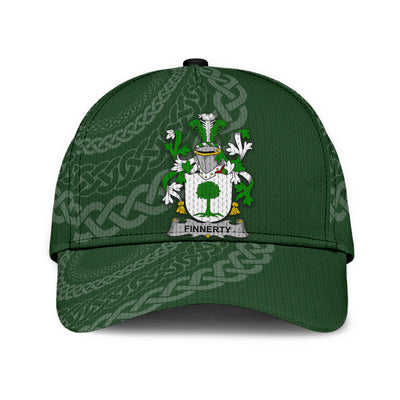 Finnerty Coat Of Arms - Irish Family Crest St Patrick's Day Classic Cap$42.45