Irish formÓ Deaghaidh
Meaning'descendant of Deaghadh'
CountiesClare, Tipperary, Limerick
Other spellings4
Origin of the O'Dea name
Woulfe: (1) a Dalcassian family, still numerous in Thomond, chiefs of Ui Fearmaic, which comprised the greater part of the present barony of Inchiquin, Co. Clare, with strongholds at Tullyodea and Dyserttola; (2) a Tipperary family, anciently chiefs of Sliabh Ardacha, now anglicised Slewardagh, in the east of that county.[1]
- 1311Four Masters: Loughlin Reagh O'Dea slain by Mahon, son of Donnell Connaghtagh O'Brien.[7]
- 1400Cornelius O'Dea, Archdeacon of Killaloe, appointed Bishop of Limerick.[11][10]
- 1418Date in the inscription of the crozier Bishop Cornelius O'Dea had made.[12]
- 1588Four Masters: O'Dea (Mahon, son of Loughlin), Lord of Kinel-Fearmaic, died.[8]
- 1589Four Masters: Dermot Oge O'Dea died and was buried in his own town of Disert-Tola.[9]
- 1690'O DEA' appears in Sir James Terry's list of Irish septs.[6]
- 189035 entries incl. spelling varieties (34 O'Dea); 17 in Clare, 6 in Limerick.[3][4]
O'Dea surname: questions
What does the surname O'Dea mean?
Woulfe gives O'Dea as one of the English forms of Ó Deaghaidh, 'descendant of Deaghadh'.[1]
Where in Ireland is the O'Dea name from?
Woulfe names a Dalcassian family, chiefs of Ui Fearmaic, which comprised the greater part of the present barony of Inchiquin, Co. Clare, with strongholds at Tullyodea and Dyserttola; and a Tipperary family, anciently chiefs of Sliabh Ardacha, now anglicised Slewardagh. In 1890, 17 of the 35 O'Dea birth entries (including spelling varieties) were in Clare and 6 in Limerick.[1][3]
Are Dea and Dee the same name as O'Dea?
Woulfe lists Dea, Dee and Day among the English forms of Ó Deaghaidh. He also gives Godwin and Goodwin, explaining that Godwin was suggested by the likeness of the first syllable of the variant Ó Diaghaidh to Dia, God.[1][2]
What is the O'Dea crozier?
A crozier seven and a half feet in height, made of silver for the most part. Its inscription says Cornelius O'Dea, Bishop of Limerick, had it made in 1418. The Diocese of Limerick Heritage Project says the crozier and his mitre are on display in Limerick's Hunt Museum.[12]


 Dea Coat Of Arms - Irish Family Crest Classic Cap$33.45
 Odea Coat Of Arms - Irish Family Crest St Patrick's Day Classic Cap$42.45
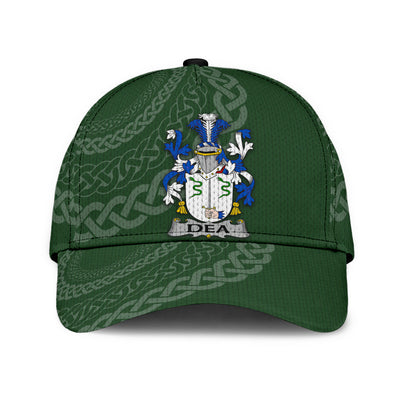 Dea Coat Of Arms - Irish Family Crest St Patrick's Day Classic Cap$42.45
 Dea Coat of Arms – Irish Family Crest Glass Ornament$24.99
 Dea Coat of Arms – Irish Family Crest Ornament$19.99
 O'Dea Coat of Arms – Irish Family Crest Glass Ornament$24.99
 O'Dea Coat of Arms – Irish Family Crest Ornament$19.99
